
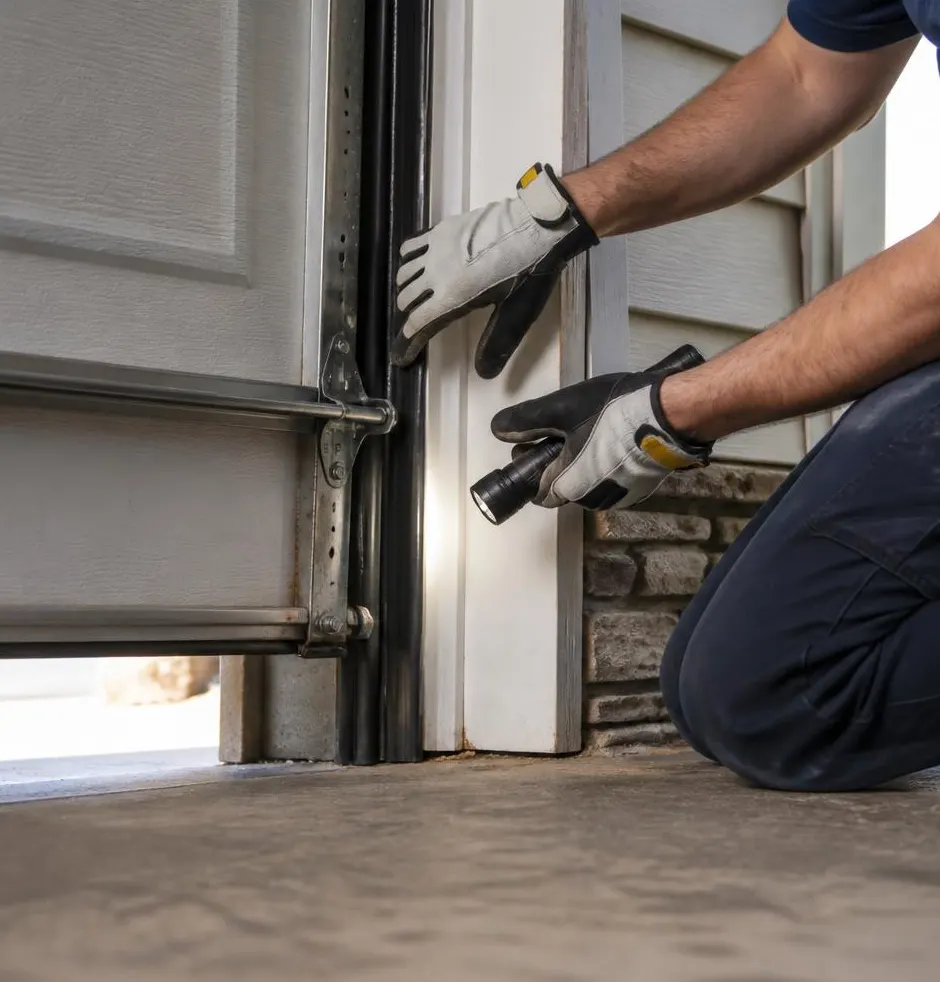
On a typical fall service call in Aberdeen, Southern Pines, or Pinehurst, the story is almost always the same. The homeowner presses the button, the door drops a foot or two toward the concrete, and then it reverses straight back up before it ever touches down. Sometimes it's worse than that — the opener light blinks, the motor hums, but the door doesn't move at all. Either way, it's not a problem to ignore. A door that won't close reliably is a security gap, and a door that reverses unpredictably is usually telling you something is binding, misaligned, or worn out.
What This Usually Looks Like
Before getting into causes, it helps to know which symptom you actually have, since that changes where the problem lives:
- Door starts down, stops a few inches off the floor, and reverses every single time.
- Door reverses only when closing in one direction or only on humid, rainy days.
- Door won't move at all; the opener motor runs but the trolley doesn't travel.
- The opener's safety light blinks a set number of times (check your owner's manual — this is a built-in diagnostic code).
- Door closes fine manually (disconnected from the opener) but not with the remote or wall button.
That last point matters: if the door moves smoothly by hand with the opener disengaged, the problem is almost always electronic — sensors, wiring, or opener settings — not the door itself. If it's heavy, stiff, or uneven by hand, you're looking at a mechanical issue in the door system.
Causes, in the Order a Technician Checks Them
1. Safety sensor alignment and dirty lenses
This is the first thing any technician checks, and it's the most common cause by far in this region. The two small sensors near the bottom of the tracks have to be aimed at each other within a few degrees. Heavy rain, pollen film, and the humidity that sits around Sandhills garages for much of the year all coat those lenses or fog them slightly, which is enough to make the opener think something is blocking the door. The fix is simple: wipe both lenses with a soft cloth, confirm both indicator lights are solid (not blinking), and nudge the brackets until they line up. If a bracket has been bumped — by a bike, a trash can, or a stored ladder — it may need to be re-bolted and re-aimed entirely.
2. Sensor wiring and connections
If the lenses are clean and aligned but the lights still won't go solid, the next check is the wiring running along the track to the opener. Moisture intrusion, rodent activity, or a loose wire nut at a splice can cause an intermittent signal — which explains why some doors only act up on wet days. This usually means re-securing or replacing a short run of sensor wire.
3. Track obstruction or misalignment
Pine needles, leaf litter, and debris blown in during fall storms or the remnants of a tropical system can lodge in the track or roller path. A technician runs the door manually to feel for binding points, checks the track brackets for looseness, and clears any debris. If a track has been knocked out of alignment, it gets re-set and re-bolted to the frame.
4. Close-force and limit settings
Every opener has a travel limit and a force setting that tells the motor how hard to push before it assumes it's hit an obstruction. If these drift out of adjustment — which happens naturally over years of use, or after a battery backup swap — the door can reverse even with clear sensors and a clean track. Recalibrating these settings is a quick in-panel adjustment, but it should only mask a real problem if nothing mechanical is found first.
5. Worn rollers or hinges
Humidity swings and the freeze-thaw cycle from an occasional ice storm take a toll on nylon rollers and steel hinges over time. Worn or dry rollers drag instead of rolling smoothly, and the opener's force sensor reads that drag as an obstruction. The fix is replacing rollers and hinges and lubricating the hardware with a silicone-based garage door lubricant — not household oil, which attracts grit.
6. Spring tension loss
If the door feels heavy when operated manually, or the opener strains audibly before reversing, torsion or extension springs may have lost tension. A door with weak springs puts extra load on the opener's drive system, which trips the force sensor on every cycle. Spring tension is checked by balance-testing the door with the opener disconnected; if it won't stay roughly level when lifted halfway, the springs need attention. This is not a DIY repair — torsion springs are under enough tension to cause serious injury, and replacement requires the right winding bars and clamps.
7. Circuit board or motor failure
If every mechanical and sensor check comes back clean and the door still won't respond correctly, the opener's circuit board itself may be failing. This is checked last because it's the least common cause and the most expensive to rule in — but after years of humidity exposure in an unconditioned garage, boards do eventually corrode or short out.
When to Call Aberdeen Garage Door Works
If cleaning the sensors and clearing the track doesn't solve it, or if the door is heavy, uneven, or making grinding noises when it moves, it's time to call in a technician rather than keep testing the opener. Our Garage Door Repair visits start with exactly the sequence above — sensors, track, limits, hardware, springs — so we fix the actual cause instead of guessing. If springs are involved, our Spring Replacement service handles that safely with the right tools, and we'll rebalance the door before we leave.
If your garage door in Aberdeen, Southern Pines, Pinehurst, or anywhere else in Moore County is closing and reversing, or won't close at all, call Aberdeen Garage Door Works today and we'll get it diagnosed and working before it becomes a bigger problem.